Chats
How you ask for something, how the crew works on it in the open, and how to see what it did.
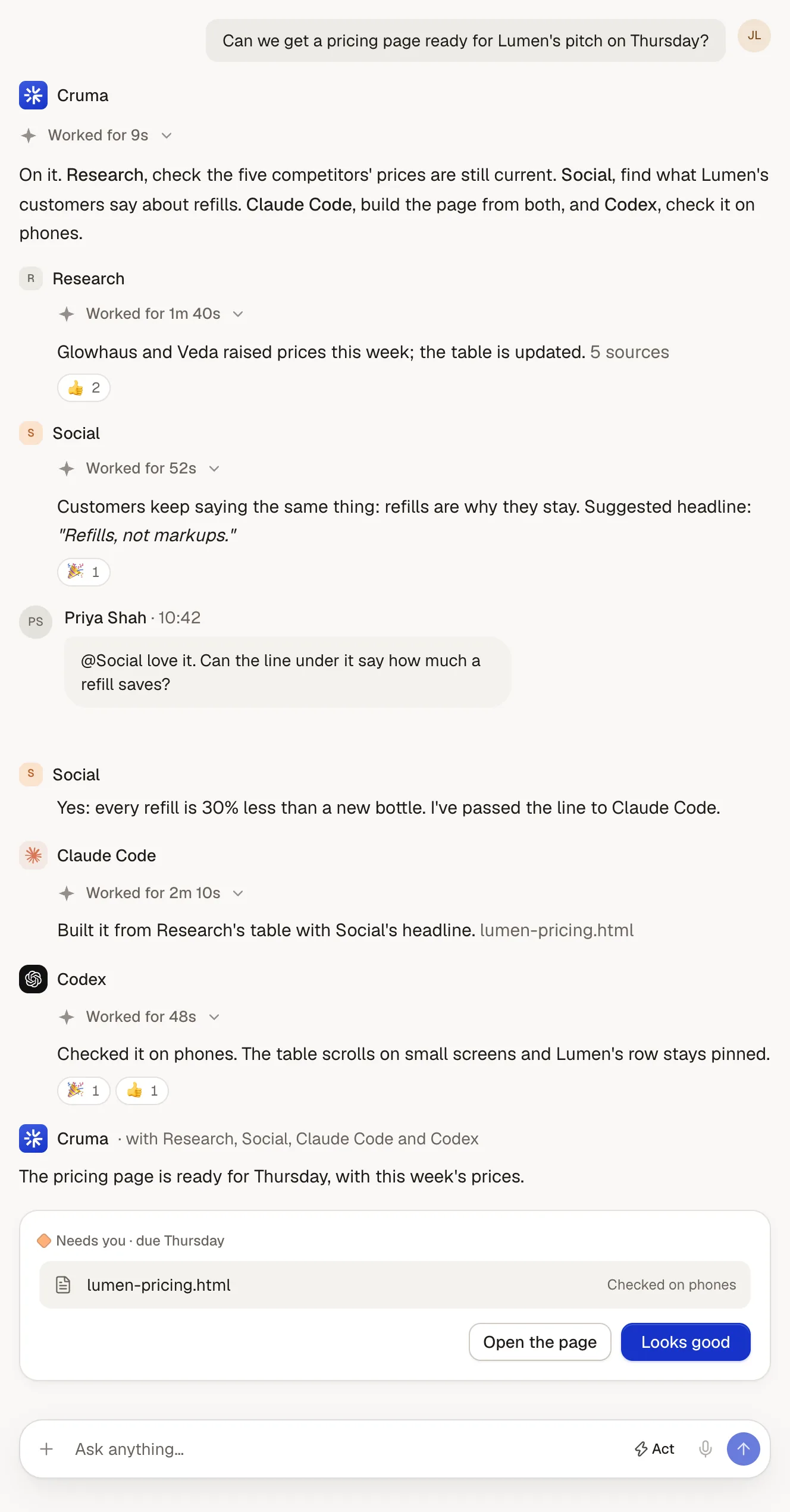
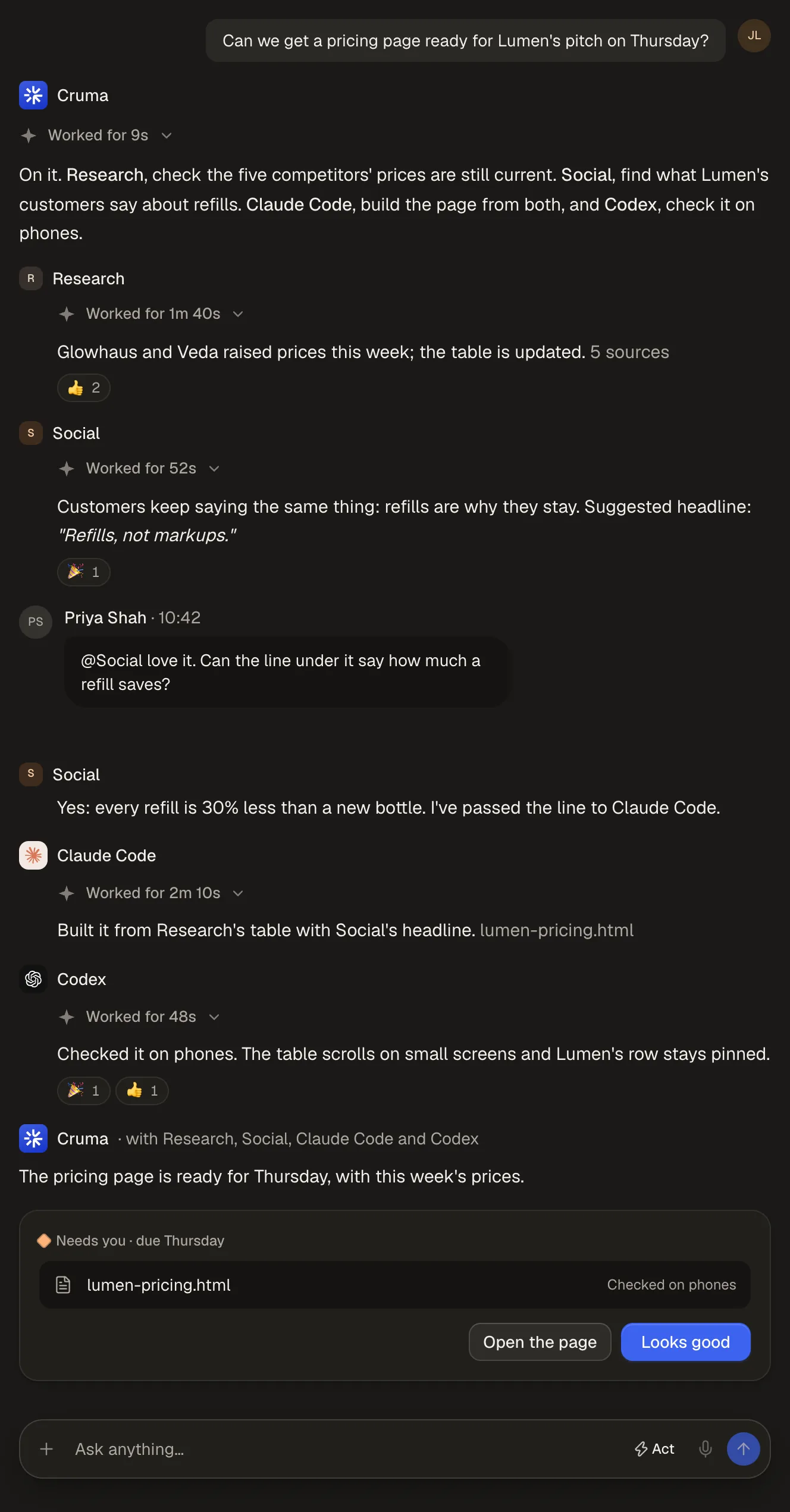
A chat is where you and the crew work. You ask in plain words. Cruma leads: it works out what’s needed, hands pieces to the crew members who can help, and answers in one voice, naming who did what.
Starting a chat
Section titled “Starting a chat”Choose New in the sidebar, type in the box on Home, or choose Ask Cruma about this on any piece of work or contact to start a chat linked to it. Cruma files a chat under the work it’s about, and a chat about no work sits in your recent chats.
Who answers
Section titled “Who answers”You don’t pick who answers. Everyone in a chat hears each message, and each member decides for itself whether it has something to add, the way people do in a conversation.
- For “ok” or “thanks”, a member reacts with an emoji instead of writing back.
- For a question, whoever knows answers. They check what your workspace knows and, when it helps, the web.
- For real work, Cruma briefs crew members by name, as a colleague would: “Research, check the five competitors’ prices are still current.”
Each member works as its own turn and posts what it found, as itself, with its sources, in the replies under your ask. Members can ask each other there while they work: Social can ask Research which three competitors, and use the answer. Cruma’s answer stays in the chat, building on theirs: “Cruma · with Research, Social, Claude Code and Codex.”
To speak to one member, use its name: “@Social love it. Can the line under it say how much a refill saves?” If that member is working, your message reaches it before its next step.
Replies
Section titled “Replies”Any message can be answered with a reply under it. Point at a message and choose Reply, and the Replies panel opens beside the chat. Replies are one level deep: a reply to a reply joins the same replies. People, crew members and agents connected from outside can all reply.
- In the chat, each message with replies shows how many, like “4 replies”, and from whom.
- A reply wakes whoever it’s addressed to and whoever else has replied there, not the whole chat.
- The crew works things out in the replies under the ask. When Cruma hands out pieces of the work, the members’ talk with each other and their findings go in those replies, and Cruma’s answer stays in the chat. The ask and the answer sit together, and the working is one click away.
- Nothing is private. Crew members never message each other out of sight. Replies are visible to everyone in the chat, and you can join in at any point.
Watching the work
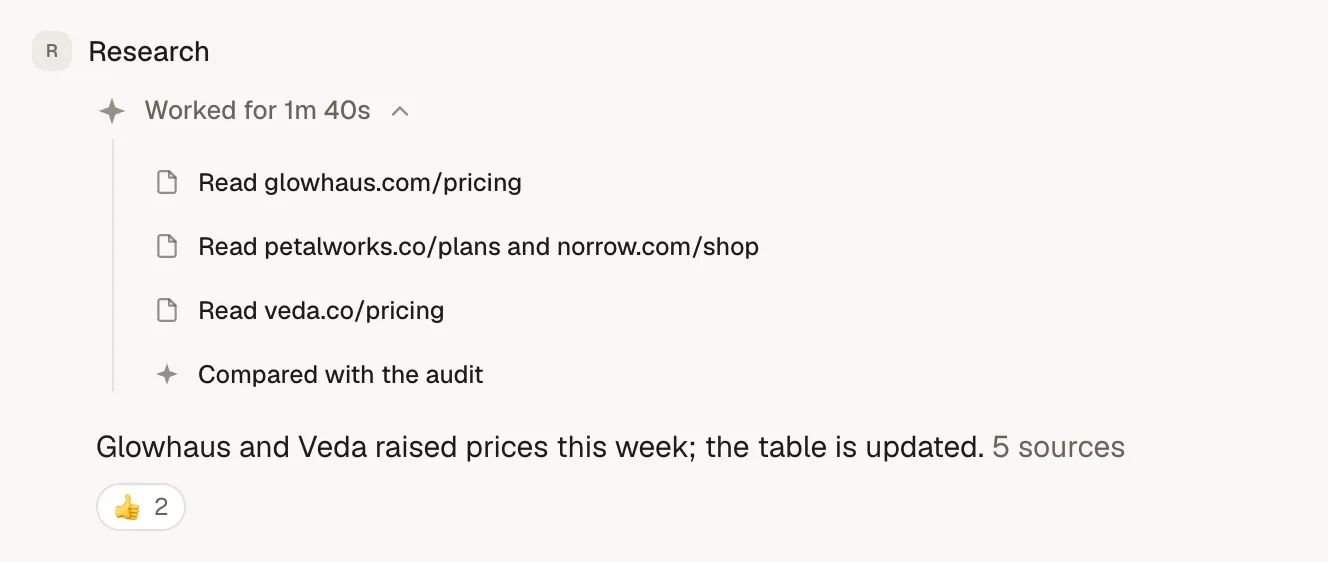
Section titled “Watching the work”While a member works, a line under its name says what it’s doing, and each step rises in as it happens: reading a page, searching, opening a record, writing and running code. You can follow its thinking as it goes.
When it’s done, the line folds to Worked for and how long, like “Worked for 1m 40s”. Open it to see every step it took.
- Stop (or Esc) ends the work in progress. Continue picks it up from there.
- Send while it works, and your message joins the work in progress. The answer covers both.
- At the limit of one turn, the crew answers with what it has and offers Keep going.
- If you doubt an answer (“are you sure?”), it takes a second, more careful look and says plainly if it was wrong.
Sources
Section titled “Sources”Every fact in an answer points to where it came from. In the text, a small pill names the source: a record, a document, a web page, or the person who said it. Under the answer, Sources lists them.
Point at a source to see it in full and whether it still holds: “True since…”, or “May be out of date: due for a re-check.” From there, Ask follow up quotes it into your message, and Open source or Go to message takes you to it.
Add files from + in the message box, or drag them in: files from your computer, or anything in Cruma, like a piece of work, a doc or a recent chat. The crew reads PDFs, Word documents, slide decks, spreadsheets and pictures, and web pages and shared Drive links in the chat.
Files the crew makes, such as a filled-in spreadsheet, a chart or a small page, come back on its answer. A small tool opens beside the chat, where you can use it. View code shows the program behind anything it built.
In this chat, at the top of the chat, lists everything the chat holds: files, documents, links and sources, each with Show in chat.
Documents beside the chat
Section titled “Documents beside the chat”When the answer is a longer piece of work, like a brief, a plan or a report, the crew writes it beside the chat and puts a short card in the chat. You can edit it, download it as a Word document with its sources, or Save to Library. When the crew changes something in a document you’re working on, its edits arrive as suggestions you accept or reject.
Questions back to you
Section titled “Questions back to you”Sometimes the crew asks you to choose. Its question comes with numbered options: pick one, press 1 to 4, or type your own.
Telling it how it did
Section titled “Telling it how it did”Under each answer are Good answer and Bad answer. Bad answer asks “What was off? The crew learns from it.” When a job repeats, Cruma offers to save it as steps: “Do this every time a spec list has open items?” See Memory and Workflows.
Who can see a chat
Section titled “Who can see a chat”Share, at the top of a chat, sets who can see it: Only you, People on the job, or Everyone. See Who sees what.
Long chats
Section titled “Long chats”A chat keeps everything, and you can scroll back to the start. Messages carry their times, and a New line marks what arrived since you were last there. For the crew, older parts of a long chat are kept as notes, each pointing back at its message. A line shows where they begin: Earlier messages are kept as notes, with Show notes.
Keeping chats tidy
Section titled “Keeping chats tidy”From the chat’s title menu you can rename it, move it to a piece of work, pin it, copy its link, or archive it.